

Regardless of how well an investment fund or manager may have done in the past, data is very clear that there is no guarantee that a top performing manager will be able to continue this.
In fact, from Carhart in 1997 onwards, studies indicate that there is more evidence that poor performance repeats than that good performance does. Fama and French, revising their earlier work in 2010, were very clear that there was little to differentiate between skill and luck and Morningstar’s research of various markets has confirmed that the best predictor of returns is fees, as it is the only guaranteed factor in performance.
I’d argue that the best use of past performance is really in understanding what the asset structure of the investment might mean, by way of performance and volatility, relative to other potential investments. Seeing how investment A performed relative to investment B during good and bad times in order to get a feel for which one might have been more comfortable with, as part of the broader discussion of risk and success.
What I hadn’t considered in much detail until recently are the perils not of past performance but of simulated past performance.
This is where an investment fund or portfolio that has a relatively short track record has performance over the longer term shown by simulating the performance that it might have had prior to the date that it started.
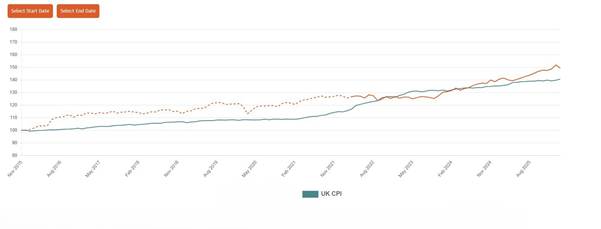
Looking recently at performance on an asset manager’s website recently, they showed performance of their seven risk rated funds, benchmarked mostly against inflation plus a margin. As we are big fans of relevant benchmarks, it was nice to see CPI being used rather than the more usual peer group indices.
However, I noticed that there was a dotted line on the graphs, stretching back to November 2015 and, down in the very long disclaimer paragraphs, was a note that prior to April 2022 the data was simulated performance rather than actual performance. No explanation of why November 2015 was used, but it meant that there was more simulated performance than actual performance on show.
Not a problem necessarily, and anyone looking at the website would have been reassured by the over 10 years of outperformance of the inflation related benchmark, net of investment manager fees and underlying costs as well.
However, being a little nerdy, and since they offered a button that allowed you to reset the start date being used, I couldn’t avoid having a play. Setting the start date to April 2022, as the start of the real data, the picture suddenly looked very different. Although the end point showed that the CPI benchmark had been met, the impression given by the longer term chart is very different from the reality of what investors would have experienced over the last four years.
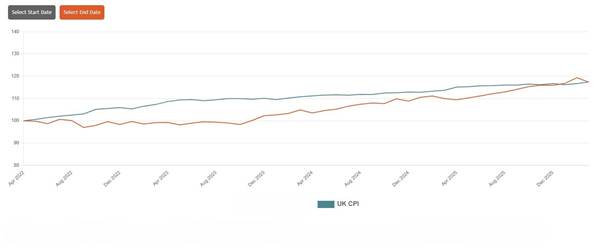
This is not to denigrate the firm concerned, since matching inflation over the last four years, given the spike that we saw in 2022, is a reasonable result; any CPI+ targeted performance figures that include 2022 aren’t going to make for great reading.
It is however a good example of how simulated past performance can be even less of an indicator of future performance, including future past performance. It is also a good example of how the decision on how one frames the data, especially the default framing that one chooses, can influence people.
Going back to beginning of our article, this is very much the same issue that is being struggled with in relation to the past performance disclaimer.
Research run by Leeds University in 2021 considered how the disclaimer “Past performance does not guarantee future results” actually influenced investors and improved investment decisions. Their conclusion was that the disclaimer isn’t effective at informing good decision-making. The disclaimer “Some people invest based on past performance, but funds with low fees have the highest future results” was much better in limiting investors from chasing past performance.
So how one presents something is as important as what one is actually presenting, which will not come as much of a surprise to anyone, and that presentation can influence people’s actions if it is done well, or fail to do so if it is not.
The key takeaways therefore are that :
Fama, Eugene F., and Kenneth R. French, (2010), “Luck versus Skill in the Cross-Section of Mutual Fund Returns”, Journal of Finance, 55
Morningstar, various inc Kinnel, R., (2016) “How Fund Fees are the Best Predictor of Returns” and Nguyen, L., (2024) “The Predictive Power of Fees”
Ayton, Professor Peter, Weiss, Dr Leonardo and Newall, Dr Philip, (2021) “Persistence is futile: Chasing of past performance in repeated investment choices”
The value of investments and any income from them can fall as well as rise. You may not get back the full amount invested. Past performance is used as a guide only; it is no guarantee of future performance.